科研动态 | 我院博士生金睿智在EPSL上发表文章:青藏高原东北缘祁连山东段的地壳差异增厚与不完全解耦
近日,我院2024届博士毕业生金睿智(现广东省城市地震安全研究所助理研究员)与导师张培震教授、沈旭章教授等人在国际著名地学期刊《Earth and Planetary Science Letters》(Nature Index,JCR一区)上发表重要研究成果,题目为“Crustal differential thickening and incomplete mechanical decoupling in the eastern Qilian Shan, NE Tibetan Plateau: Insights from a dense seismic profile”。该研究聚焦青藏高原东北缘祁连山东段,探讨了其地壳变形样式与构造演化机制。
祁连山作为青藏高原东北缘最年轻的组成部分之一,其形成与隆升机制对理解高原演化具有重要约束作用。然而,关于祁连山的变形样式究竟是纯剪变形(Shen et al., 2015, 2020; Xu et al., 2019)还是单剪变形(Feng et al., 2014; Ye et al., 2015, 2021),目前仍存在较大争议。
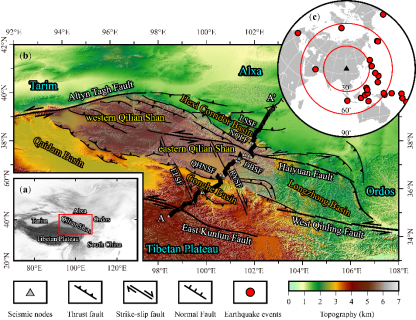
图1 (a)祁连山及其邻区构造单元位置图;(b)祁连山主要断裂及短周期密集台阵测线位置图;(c)本研究所用远震事件的震中分布图。
为厘清这一问题,研究团队在国家自然基金委重点项目资助下于2022年布设了一条横跨祁连山东段、总长640公里、台间距仅1公里的短周期密集地震台阵(图1),综合利用接收函数叠加成像、接收函数与面波频散联合反演、机器学习微震识别与精定位等手段,精细刻画了剖面下方的地壳结构。
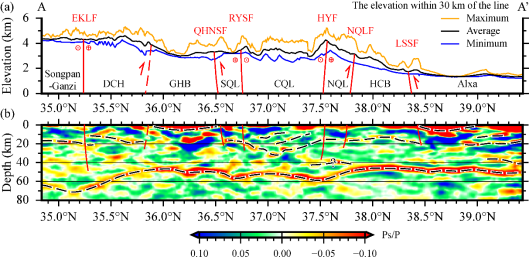
图2 测线沿线地形起伏与接收函数叠加成像结果。
SQL:南祁连;CQL:中祁连;NQL:北祁连
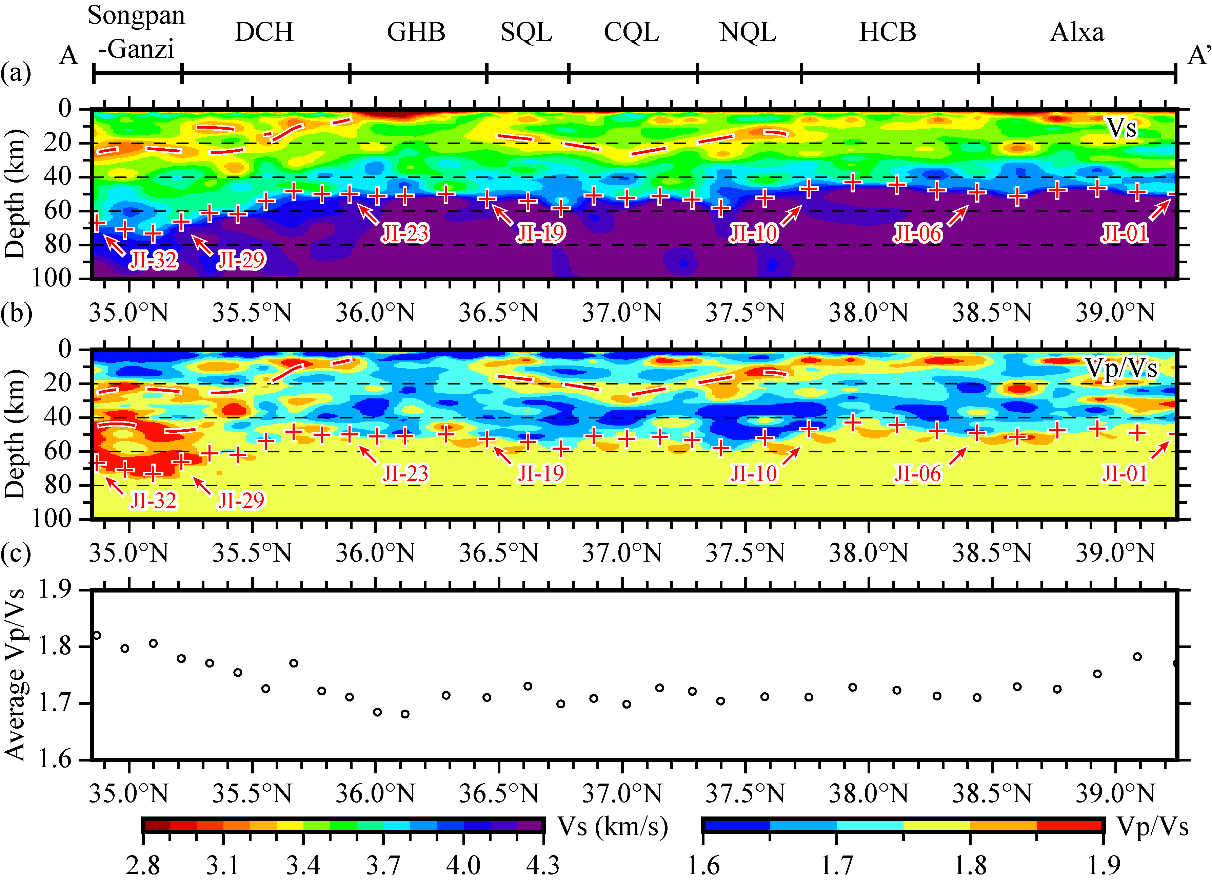
图3 接收函数与面波频散联合反演得到的Vs、地壳分层Vp/Vs、地壳平均Vp/Vs
接收函数成像结果显示,测线下方Moho面变化连续、无明显断错,在祁连山下方呈现“W”形,表明南、北祁连地壳增厚程度大于中祁连。此外,成像结果还揭示出祁连山内部上下地壳界面呈现“V”形(图2)。
联合反演获得的地壳厚度也表明祁连山地壳增厚存在显著差异:中祁连地壳厚度~52 km;而南、北祁连可达~58 km,形成了山根,山根处观察到剪切波高速体。此外,联合反演还揭示出祁连山内部存在剪切波低速层,其空间位置与接收函数成像揭示的“V”形上下地壳界面位置重合(图3)。
地震精定位结果显示,地震主要分布在上下地壳分界面之上,仅在主要深大断裂下方观测到少量地震事件,例如海原断裂下方约40 km深度处的地震,并没有观察到与岩石圈俯冲相关的贝尼奥夫带。
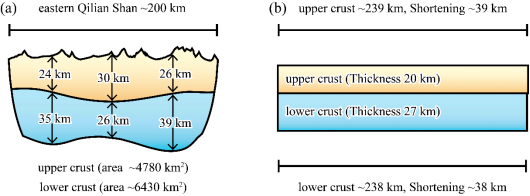
图4 通过平衡剖面分析确定的祁连山东段新生代上下地壳缩短量

图5 祁连山东段新生代构造演化示意图
综合连续的Moho面形态、地震精定位结果及野外观察到的盆山间高角度逆冲断层,我们认为祁连山东段的构造变形样式以纯剪变形为主。平衡剖面分析显示,祁连山东段上地壳与下地壳的缩短量相当,壳内的剪切波低速层作为滑脱层协调了局部差异变形(图4)。从整个造山带的宏观角度来看,祁连山的构造变形属于不完全解耦变形(图5)。
文章第一作者为金睿智助理研究员,通讯作者为我院沈旭章教授和张逸鹏副教授。该项目得到国家自然科学基金(42230305, 42030301)资助。
论文信息:
Jin, R., Shen, X.*, Zhang, Y.*, Deng, Y., Wang, W., Cheng, S., Liu, K., Huang, H., Jing, H., Zhang, P., 2026. Crustal differential thickening and incomplete mechanical decoupling in the eastern Qilian Shan, NE Tibetan Plateau: Insights from a dense seismic profile. Earth Planet. Sci. Lett. 684, 120032. https://doi.org/10.1016/j.epsl.2026.120032.
参考文献:
Feng, M., Kumar, P., Mechie, J., Zhao, W., Kind, R., Su, H., Xue, G., Shi, D., Qian, H., 2014. Structure of the crust and mantle down to 700 km depth beneath the East Qaidam basin and Qilian Shan from P and S receiver functions. Geophys. J. Int. 199(3), 1416–1429. https://doi.org/10.1093/gji/ggu335.
Shen, X., Yuan, X., Liu, M., 2015. Is the Asian lithosphere underthrusting beneath northeastern Tibetan Plateau? Insights from seismic receiver functions. Earth Planet. Sci. Lett. 428, 172–180. https://doi.org/10.1016/j.epsl.2015.07.041.
Shen, X., Li, Y., Gao, R., Chen, X., Liu, M., Yuan, X., Kind, R., Xiong, X., Zhang, Y., Qian, Y., Li, M., Mei, X., 2020. Lateral growth of NE Tibetan Plateau restricted by the Asian lithosphere: results from a dense seismic profile. Gondwana Res. 87, 238–247. https://doi.org/10.1016/j.gr.2020.06.018.
Xu, Q., Pei, S., Yuan, X., Zhao, J., Liu, H., Tu, H., Chen, S., 2019. Seismic evidence for lateral asthenospheric flow beneath the northeastern Tibetan plateau derived from S receiver functions. Geochem. Geophys. Geosyst. 20(2), 883–894. https://doi.org/10.1029/2018GC007986.
Ye, Z., Gao, R., Li, Q., Zhang, H., Shen, X., Liu, X., Gong, C., 2015. Seismic evidence for the North China plate underthrusting beneath northeastern Tibet and its implications for plateau growth. Earth Planet. Sci. Lett. 426, 109–117. https://doi.org/10.1016/j.epsl.2015.06.024.
Ye, Z., Gao, R., Lu, Z., Yang, Z., Xiong, X., Li, W., Huang, X., Liang, H., Qi, R., Shi, Z., Zhou, H., Dong, X., 2021. A lithospheric-scale thrust-wedge model for the formation of the northern Tibetan plateau margin: evidence from high-resolution seismic imaging. Earth Planet. Sci. Lett. 574, 117170. https://doi.org/10.1016/j.epsl.2021.117170.
供稿:金睿智 沈旭章
初审:董晓涵 黄荣
审核:郑义 徐永怡
审核发布:孔晓慧